Knowing how to tell real leather from fake is one of the most practical skills a leather buyer can have, and it takes less than a minute once you know what to look for. The challenge is that faux leather (PU leather, bonded leather, vegan leather made from synthetic materials) has become very convincing at first glance. Brands sometimes obscure the distinction deliberately, using language like “premium leather” or “genuine leather” without being specific about what they actually mean.
These six tests work in stores, at markets, or when shopping online if you can zoom in on product photos. Each test takes seconds. Together, they will tell you what you are actually holding.
Why It Matters
The gap in longevity between real leather and faux leather is significant. A quality full-grain leather wallet or bag, properly maintained, can last a decade or more and get more characterful with age. A faux leather piece, regardless of how it is marketed, typically shows cracking, peeling, or surface breakdown within two to five years of regular use.
This is not a judgment call about price points or personal values. It is a factual difference in material behavior over time, and it is worth knowing before you buy.
Test 1: The Smell Test
What to do: Hold the piece close and take a clear sniff of the material, especially at a seam or interior where the surface hasn’t been treated with a finishing spray.
What real leather smells like: Real leather has a distinctive, clean, earthy smell, organic, slightly woody, with a depth that is hard to mistake once you know it. Vegetable-tanned leather, like the leather used at Arbor Trading Post, has a particularly pleasant and pronounced natural scent.
What faux leather smells like: Synthetic materials (PU leather, PVC, bonded leather) have a faint plastic or chemical smell. It is sometimes masked by finishing sprays in a store environment, but it is usually detectable if you smell an interior seam or unfinished edge. The smell can range from faintly sweet (PU) to more acrid (PVC).
Reliability: High. Smell is one of the hardest things to fake convincingly, and the difference is clear once you have smelled both. If you are uncertain, smell a known leather piece (your own wallet or belt) for comparison.
Test 2: The Edge Test
What to do: Look closely at the cut edges of the material such as along the top of a wallet, the cut edge of a strap, the inside seam of a bag. If the piece is in a store, turn it over and find an unfinished or partially finished edge.
What real leather edges look like: Real leather shows fibrous layers at the cut edge: a slightly rough, organic texture that looks like layers of compressed fibers. Full-grain and top-grain leather will show tight, dense fibers. The edge may be burnished smooth or left raw depending on the maker, but the underlying fiber structure is visible.
What faux leather edges look like: Faux leather shows a very uniform, smooth edge with visible layers. Often a thin coating on top, a fabric or fiber backing beneath, and sometimes a foam or bonded layer in between. Bonded leather (the lowest grade of “real” leather) shows a similar construction – a thin leather dust layer over a non-leather substrate. The edge looks manufactured rather than cut from a solid material.
Reliability: Very high. The edge is the single most revealing part of a leather piece. Real leather at the edge is unmistakable. If a piece is entirely edge-finished or bound (common in lower-quality goods specifically to hide this), that itself is worth noting.
Test 3: The Grain Pattern Test
What to do: Look closely at the surface texture of the leather. Zoom into product photos when shopping online. Look for consistency across the entire surface.
What real leather grain looks like: Natural leather grain has subtle variation. Pore patterns shift slightly across the surface. The texture has organic irregularity – a small cluster of pores here, a slightly different density there. No two square inches of genuine hide are perfectly identical. Full-grain leather, in particular, may show minor natural marks (healed insect bites, slight color variation) that are signs of authenticity, not flaws.
What faux leather grain looks like: Synthetic materials have a mechanically embossed grain pattern that repeats identically across the entire surface. If you look closely, especially in raking light, you can see the same unit of texture tiling across the material. It is perfectly uniform in a way that no natural hide can be.
Reliability: High, especially with practice. Once you have seen the repetitive embossed pattern of faux leather alongside real grain, you will not confuse them again. High-quality faux leathers are getting better at varying their embossing patterns, but close inspection still reveals the difference.
Test 4: The Water Absorption Test
What to do: If you have the opportunity to touch or briefly handle the piece (in a store, at a market, or with a piece you own), place a small drop of water, or even just lick your fingertip and touch it to an inconspicuous area, and observe what happens over 30 seconds.
What real leather does: Genuine leather, especially vegetable-tanned leather, will absorb the water drop within a few seconds, leaving a slightly darker spot. The mark may linger briefly and then fade as the leather equalizes. This absorption behavior is the result of the leather’s natural porosity.
What faux leather does: Synthetic materials are non-porous. A water drop will bead and sit on the surface rather than absorbing. Wipe it away and no mark remains.
Note: Some real leathers are treated with sealers or heavy wax finishes that temporarily prevent absorption. If a real leather piece has been heavily waxed or sealed, this test may be less definitive. Combine it with the smell and edge tests for confidence.
Reliability: Moderate to high. Very useful when you can apply it. Not always possible in a retail context.
Test 5: The Flexibility and Bend Test
What to do: Gently fold a portion of the material at a corner, or a flat area and observe how it responds to bending and what happens when you release it.
What real leather does: Real leather bends smoothly and returns to shape without cracking. When you bend it, the surface shows natural compression wrinkles that disappear when you release it. Full-grain leather in particular is flexible and resilient. If you squeeze a piece of real leather firmly, the area may show a slight lighter crease temporarily, then recover, similar to how a pull-up leather responds to pressure.
What faux leather does: Faux leather at lower quality levels will crack at bend points under repeated flexing – this is the “peeling” you see in aged faux leather pieces. Even before cracking, faux leather often shows a less organic bending behavior: stiffer, with a slightly plasticky resistance. When you bend it sharply, it may show a whitening at the crease that does not recover cleanly.
Additional signal: Press your thumbnail firmly into a test area of real leather (in an inconspicuous spot) and release. Real leather will show a slight impression that slowly recovers. Faux leather either shows no impression (very stiff) or a sharp crease that stays.
Reliability: Moderate. Better at identifying lower-quality faux leather; very high-quality PU leather can fool this test briefly.
Test 6: The Price Reality Check
What to do: Consider the price in context of what you know about leather production costs.
What real leather costs: Quality full-grain leather is expensive before a single stitch is made. Badalassi Carlo’s Tuscan hides cost significantly more than commodity leather precisely because of the slow vegetable tanning process, the quality of the hides selected, and the labor of skilled Tuscan tanners. A handcrafted full-grain leather wallet with quality hardware, hand-stitching, and finished edges requires skilled labor in addition to the material cost.
This means real full-grain leather goods, especially handmade ones, have a floor price. A “handcrafted genuine leather” wallet at $19 is telling you something about what is actually in it.
What this test tells you: Price alone cannot confirm quality. There are overpriced faux leather products and fairly priced real leather ones. But price that is implausibly low for claimed quality is a reliable signal that something in the material story is not true. A full-grain leather bifold wallet made in the USA or Western Europe from Italian tannery leather will cost at least $50–70 at its most modest and considerably more for skilled handcrafted production.
What to ask: When price seems suspiciously low for the claimed quality, ask the seller what tannery the leather comes from. If they cannot answer, or if the answer is vague, that tells you something.
Putting the Tests Together
No single test is definitive on its own, but three or four tests used together will give you a clear answer in almost every case. In practice, a quick sequence looks like this:
- Smell it — does it smell like organic leather or plastic?
- Find an edge — does it show fibrous layers or a laminated sandwich?
- Look at the grain — does it show organic variation or mechanical repetition?
- Bend a corner — does it flex smoothly or resist plastically?
That 30-second sequence will resolve most questions.
What to Look for at Arbor Trading Post
All leather used in our Ann Arbor workshop is full-grain vegetable-tanned, sourced from Badalassi Carlo or Conceria Walpier in Tuscany or top US tanneries. Every piece shows natural grain variation, develops patina with use, absorbs water at the cut edges, and has the distinctive smell of genuine vegetable-tanned hide.
If you are shopping for your first serious leather piece and want to experience the difference firsthand, our wallets are a low-stakes entry point:
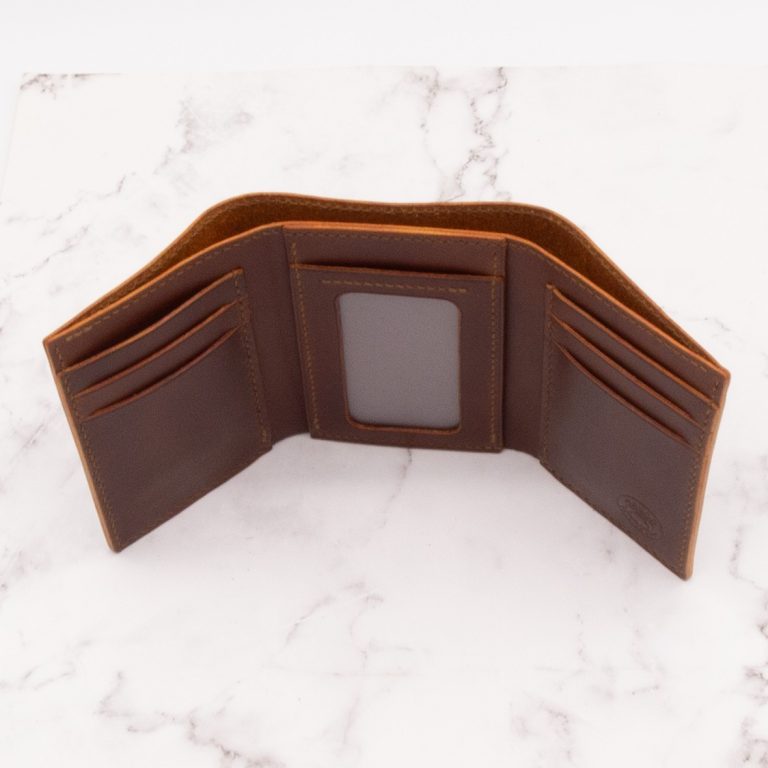
- Classic Leather Bifold Wallet — Rustic Smooth — a clear example of natural full-grain veg-tan grain and texture
- Slim Bifold Card Holder — minimal and well-finished; good for examining edge work
- Handcrafted Leather Ultra Slim Bifold Wallet in Olive Green and Sunflower Yellow — distinctive color, same full-grain construction
For more on leather grades and what makes one wallet worth more than another, see our guides on full-grain vs. top-grain leather and vegetable tanning vs. chrome tanning.
Subscribe to Our Newsletter
Want a practical leather education without the marketing noise?
We write occasional notes from our Ann Arbor studio covering how to evaluate leather, what our hides look and feel like in practice, and how to care for pieces you plan to own for a long time. It is the kind of information that makes you a better buyer, whether you shop with us or not.
Subscribe to the Arbor Trading Post newsletter →