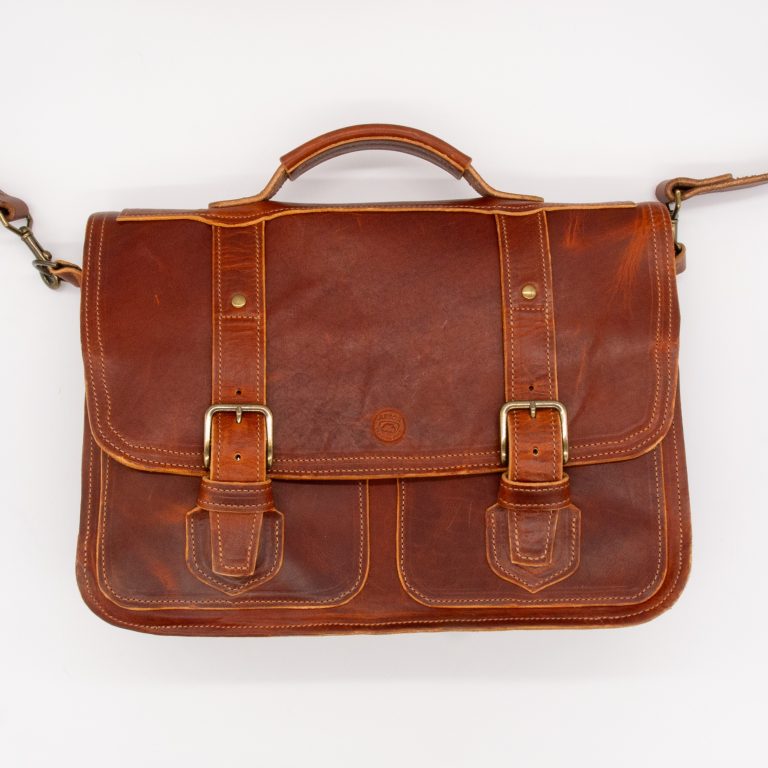
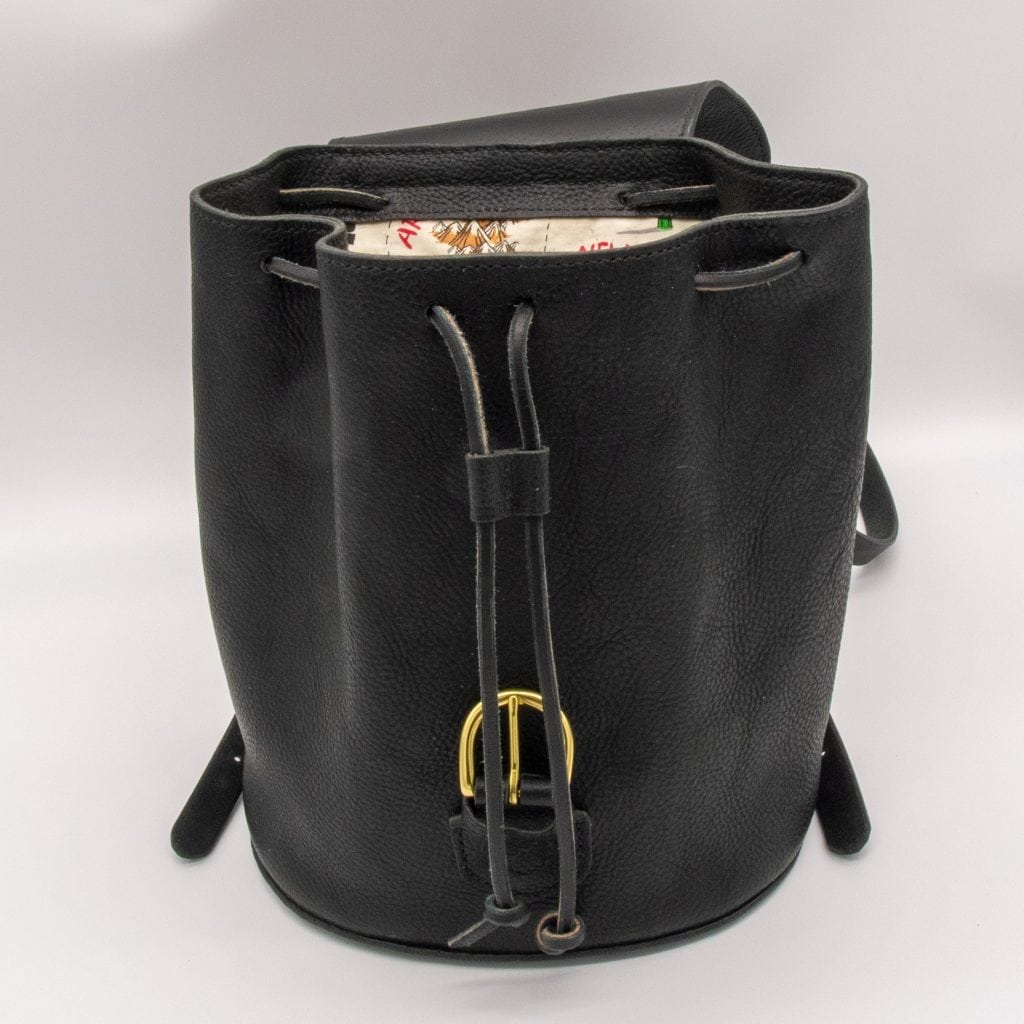
Knowing how to spot quality in a leather bag is the single skill that separates a purchase you’ll carry for two decades from one you’ll replace in two years. The signs are visible if you know where to look. This guide walks through seven concrete markers, why each one matters, and what to expect when a bag is built the right way.
At Arbor Trading Post, every bag starts with hides from Tuscan or American tanneries where vegetable-tanning process takes weeks, not hours. That origin shapes everything downstream: how the leather smells, ages, holds its structure, and responds to the craft. These seven markers are what we look for ourselves and what you should look for in any bag you’re considering.
Marker 1: Full-Grain Leather. The Only Grade That Ages Well
The outer surface of a hide (the grain) is the densest, most tightly woven fiber layer in the entire skin. Full-grain leather preserves it entirely. Nothing is sanded, buffed, or corrected away.
Every other grade: top-grain, genuine leather, bonded leather, removes or splits away from this layer to some degree. That correction process eliminates the natural character of the hide, but it also strips the fiber density that gives leather its durability. Top-grain bags look uniform from the shelf. Full-grain bags look better after ten years of carry.
Our hides are full-grain by definition. The tannery’s vegetable-tanning method using bark extracts and plant matter rather than chromium salts produces leather that develops a patina over time, deepening in color at the stress points and softening in the body. That process cannot be faked with a lower grade.
How to check: Look for natural grain variation. Small marks, subtle color shifts, and grain irregularities are features, not flaws. Uniform, plastic-smooth surfaces signal correction. If a product listing doesn’t say “full-grain,” assume it isn’t.
Marker 2: Even, Tight Stitching That Doesn’t Wander
A bag’s structural integrity lives in its stitching. Pull on any seam: that thread is holding the load every time you lift the bag off a chair, over your shoulder, or out of an overhead bin.
Quality stitching is consistent: even tension across the entire seam, uniform spacing between stitches, no loops or skipped holes. On a handcrafted bag, the craftsperson pre-punches each hole with a pricking iron before running the thread through. This takes longer than a machine can manage, but it produces seams that are both stronger and more precise.
Look at the ends of every seam. Cleanly backstitched and knotted (or, better, flame-sealed) ends indicate attention to the part of the bag most likely to unravel. A thread tail that’s simply clipped and exposed will fray within months.
On ATP bags, stitching is done by hand or on a heavy-duty leather stitching machine that maintains needle tension appropriate for the hide’s thickness. No shortcuts on seam endings.
Marker 3: Burnished, Finished Edges; Not Raw or Painted
Bag edges are where cheaper construction reveals itself fastest. When a hide is cut, the cross-section of the leather – the raw edge – is fibrous and unfinished. Left that way, it absorbs moisture, frays, and delaminates over time.
A quality bag finishes every exposed edge. The two best methods: beveling the corner first, then burnishing with a wooden slicker and edge paint or beeswax until the surface is smooth and sealed; or folding the leather back over itself and stitching it closed (called a turned edge). Both take time. Both indicate a maker who considers the edge a finished design element.
Painted edges that crack or peel within six months are the telltale sign of a shortcut. Properly burnished edges develop their own patina alongside the leather face.
At the Ann Arbor studio, edges are beveled and burnished (or turned) on every panel before assembly. Run a fingernail along the edge of any ATP bag. It feels smooth and solid, not fibrous or layered.
Marker 4: Hardware That Holds Its Finish
Zippers, clasps, D-rings, and swivel hooks take more mechanical stress per day than almost any other component. Budget hardware is made from zinc alloy, plated in a thin finish that scratches and tarnishes quickly. Quality hardware is solid brass, gunmetal, or stainless steel – heavier, with finishes that either develop character or hold up indefinitely.
Test it: work a zipper several times. It should run smoothly with resistance: not grinding, not slipping. Flex a D-ring. It should hold its shape without deflecting. On a magnetic closure, the snap should feel decisive, not mushy.
YKK or Riri zippers are the minimum bar for quality bags. On ATP messenger bags and crossbody bags, hardware is selected for weight-appropriate strength. You’ll notice the extra gram of a brass swivel hook immediately.
Marker 5: A Clean, Intentional Interior Lining
The interior of a bag is invisible in most product photos and in most buying decisions. It’s also where you’ll spend ten seconds every time you reach for your phone, your laptop, or your keys.
A quality lining is either heavy canvas, full-grain leather, or quality microfiber. Tightly woven, cleanly finished at every seam and pocket opening. Pockets that are stitched rather than glued. Fabric that doesn’t snag on watch crowns or earrings.
Avoid linings that are obviously thin and slippery, or that show visible glue at the seams. They signal a bag built for the shelf, not for use.
Marker 6: Shape Retention Under Load
A bag that holds its form whether loaded or empty has structure built into it: a firm base panel, interfaced side walls, or a leather thick enough that it carries itself. A bag that collapses into a shapeless pile when set down on a table is either under-engineered or built from a hide too thin for the form factor.
The Medium Leather Crossbody Messenger Bag and the Handcrafted Crossbody Satchel Bag in Chestnut both use hide weights selected for structural integrity. Thick enough at the base and sides to hold their silhouette when placed on a table empty. That’s a deliberate material decision, not an accident of which hide was cheapest.
Marker 7: The Smell: Vegetable-Tanned Leather Has One
This one can’t be faked. Vegetable-tanned full-grain leather from a tannery like Badalassi Carlo or Wickett & Craig has a distinctive, warm, organic smell: faintly woody, faintly earthy, nothing like plastic or solvent. Chrome-tanned leather has almost no smell, or smells slightly metallic. Bonded leather and PU leather smell like manufactured products because they are.
You’re not likely to smell a bag before buying online. But if you have any opportunity to handle leather goods in person, trust your nose. The smell is a reliable proxy for the entire production chain – the tannery, the hide grade, the finishing method.
How These Seven Markers Come Together
A bag that passes all seven checks is rare in the mass market. Real full-grain hide costs more than split leather. Burnished edges take time. Solid brass hardware adds weight and margin. These are choices a manufacturer makes consciously – and in mass production, margin pressure almost always wins.
The bags coming out of the Ann Arbor studio pass all seven because every decision traces back to material and craft, not unit cost. That’s the only reason we can honestly point to our hides and hand-burnished edges – both are choices, not marketing claims.
If you’re ready to apply these standards to your next bag, browse the full collection at shop or start with specific styles:
- Medium Leather Crossbody Messenger Bag
- Mini Crossbody Bag in Tan
- Handcrafted Leather Small Crossbody Messenger Bag in Green
Want to go deeper on leather quality before your next purchase?
Our newsletter goes out every few weeks with leather education, new pieces from the studio, and occasional behind-the-scenes from both the Ann Arbor workshop and the Tuscan tanneries we source from. No filler — just the kind of detail that helps you buy better and take care of what you own.
[Subscribe here — it’s free and you can unsubscribe anytime.]
For more on the material decisions behind every ATP bag, read The Artisan’s Guide to Understanding Leather Types and What Makes Handcrafted Leather Bags So Special.