
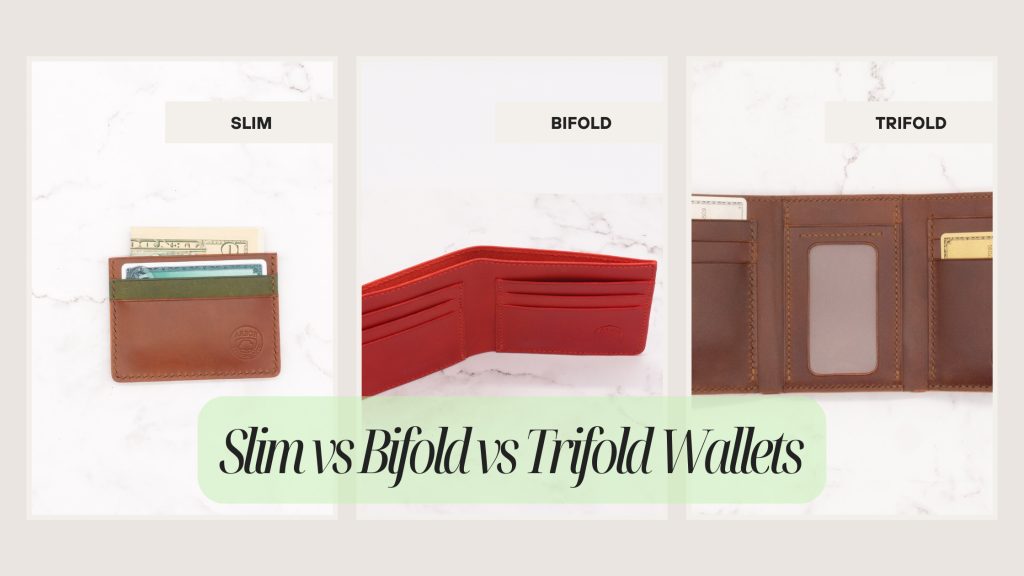
When the slim wallet vs bifold debate comes up, most people already know which camp they’re in. They just haven’t admitted it yet. The person still hauling a stuffed billfold from 2018 probably knows they need to downsize. The person reaching for a slim card holder at the coffee shop wonders if they’re missing something. And the trifold loyalist? They know exactly what they want and they’re not apologizing for it.
This guide breaks down all three styles honestly: what each holds, how each sits in your pocket, and which type of person each actually suits. No one style is universally better. But one is probably better for you.
What the Slim Wallet Does Well
A slim wallet, sometimes called a card holder or minimalist wallet, strips the wallet down to its functional core: your most-used cards and maybe a few bills folded flat.
What it typically holds:
- 3–6 cards (some designs go up to 8 with fanned pockets)
- A few folded bills, either in a dedicated slot or tucked behind the card stack
- No coin pocket; no ID window in most designs
How it sits in your pocket:
This is the slim wallet’s main argument. A well-made slim wallet sits nearly flat in a front or back pocket, doesn’t create a visible bulge under dress trousers, and eliminates the lower-back discomfort that comes from sitting on a thick billfold all day.
Who it suits:
- Tap-to-pay users who carry two or three cards at most
- Anyone in a business-casual or formal dress environment where pocket lines matter
- People who’ve already moved receipts, loyalty cards, and gift cards to a phone wallet app
- Frequent travelers who want minimal bulk in a jacket pocket
At Arbor Trading Post, our slim designs are cut from the same full-grain Italian leather that goes into every piece we make — so even a card holder that’s 4mm thick carries the same depth of character as a wallet twice its size. The Slim Bifold Card Holder and the 5-Pocket Olive Green Card Holder are good places to start if you’re moving toward minimal.
What the Bifold Wallet Does Well
The bifold is the standard. Fold once down the center, cards on both sides, bill compartment in the middle. It’s been the default men’s wallet format for over a century because it balances capacity with a reasonable footprint.
What it typically holds:
- 6–10 cards across multiple slots
- Bills unfolded (full-length pocket)
- Some designs include an ID window or a coin snap closure
- RFID-blocking lining is easy to add at the bifold thickness without adding bulk
How it sits in your pocket:
A bifold sits well in either a front or back pocket. Empty or lightly loaded, it’s not much thicker than a slim wallet. The key variable is discipline. A bifold tempts you to carry more, and the more you load it, the more it curves in your pocket. A bifold with eight cards and a stack of receipts stops being a wallet and starts being a liability.
Who it suits:
- People who legitimately need 6–8 cards accessible (not just stored somewhere)
- Anyone who still carries cash regularly
- People who want RFID blocking built in. The RFID-Blocking Bifold is our most popular design for frequent travelers
- Someone buying their first quality leather wallet and wants something familiar
The bifold is also the most versatile format for artisan leather work. Because the panels are generous, there’s more surface to showcase full-grain texture and color. Our Rustic Smooth Leather Bifold and the Navy Blue with Yellow Stitch show how much personality a bifold can carry. These are made in our Ann Arbor studio from Badalassi Carlo and Conceria Walpier vegetable-tanned leather — the Tuscan tannery’s hides develop a distinct patina over years of use that no chrome-tanned wallet can replicate.
What the Trifold Wallet Does Well
The trifold folds twice, once at each third, creating a compact square shape rather than a rectangular panel. It holds more than a bifold in a shorter profile, but adds thickness.
What it typically holds:
- 8–12 cards
- Bills folded in thirds
- Often includes an ID window and coin compartment
How it sits in your pocket:
A trifold is shorter than a bifold when closed, which some people find easier in a front pocket. But it’s thicker. There’s no getting around the physics of three layers of leather and card slots folded on each other. For back-pocket carry, a trifold creates more pressure than a bifold.
Who it suits:
- People who carry a larger number of cards and don’t want to move to a travel wallet
- Front-pocket carriers who care more about length than thickness
- Anyone who needs a coin pocket — the trifold is one of the few wallet formats where a snap-close coin section doesn’t feel like an afterthought
Our Classic Trifold with ID Window is built for people who genuinely need the capacity. It’s made with the same care as every other piece from our Ann Arbor shop: hand-stitched, edges burnished by hand, and cut from full-grain leather.
Head-to-Head: Slim Wallet vs Bifold vs Trifold
| Feature | Slim / Card Holder | Bifold | Trifold |
|---|---|---|---|
| Card capacity | 3–8 | 6–10 | 8–12 |
| Cash carry | Folded flat / limited | Full-length bills | Bills folded in thirds |
| Pocket bulk | Minimal | Moderate | Thicker, shorter |
| Best pocket | Front or jacket | Front or back | Front |
| RFID blocking | Available | Easy to add | Available |
| Best for | Minimalists, tap-to-pay | Most people | High-card-count carriers |
The Decision Guide: Which One Should You Carry?
Choose a slim wallet or card holder if:
You carry fewer than five cards, you use your phone for most payments, you wear fitted trousers or dress clothes regularly, or you’ve been meaning to downsize for a year and just need permission to do it. Start with the Snap Minimalist Bifold Wallet or the Cedar Ridge Three-Pocket Card Holder.
Choose a bifold if:
You carry 6–8 cards, you still use cash, and you want something that works in any pocket without overthinking it. The bifold is the right answer for most people, which is why it’s been the default for this long. Browse our full collection of bifold wallets to find the right texture and color.
Choose a trifold if:
Your card count is genuinely above eight, or you carry a mix of cards, cash, and coins that no bifold can tame without becoming a brick. The Classic Trifold with ID Window is the answer.
A Note on Leather Quality (Because the Format Is Only Half the Decision)
Whatever format you choose, the material is what determines whether a wallet is still in your back pocket in ten years or at the bottom of a drawer in three. Full-grain vegetable-tanned leather, the only kind we use, develops a patina over time that gets better with wear. The oils from your hands, the slight compression of daily use, the way the color deepens unevenly in the places you touch most: none of that happens with bonded leather or PU.
Tuscan tanneries we source from, use a traditional pit-tanning process that takes months rather than days. That time investment shows up in the way the leather moves, wears, and lasts. It’s the reason buying one good wallet now costs less over a decade than replacing cheaper ones every two years.
For more on what makes leather worth the price, The Artisan’s Guide to Understanding Leather Types breaks it down without the jargon.